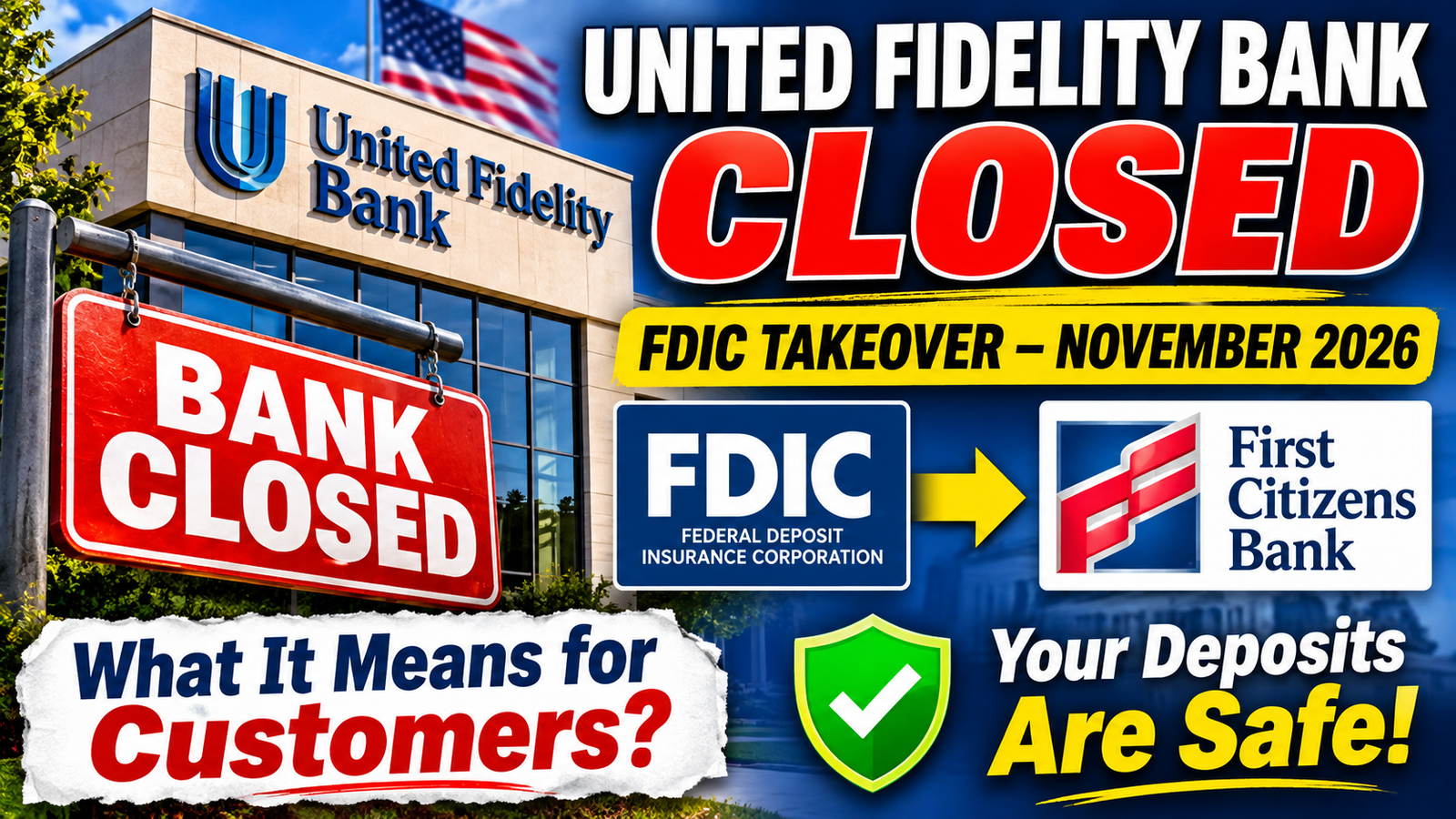
United Fidelity Bank Closed: FDIC Takeover Explained
United Fidelity Bank closed on November 27, 2026. Discover why regulators intervened, how First Citizens acquired its assets and what depositors need to know.
Table of Contents
The United States banking industry has witnessed another major development in November 2026. United Fidelity Bank, a financial institution headquartered in Evansville, Indiana, was officially closed by federal banking regulators on November 27, 2026.
The announcement attracted significant attention because the bank had approximately $5.9 billion in total assets. Following the closure, the Federal Deposit Insurance Corporation (FDIC) was appointed as receiver, and First-Citizens Bank & Trust Company agreed to acquire substantially all of the bank’s assets and assume substantially all its deposits.
Kevin Trudeau Training: 3 Powerful Keys to Online Success
This development raises several important questions. Why was United Fidelity Bank closed? What happened to its customers? Is their money safe? What is the role of First Citizens Bank? And what does this development mean for the American banking industry?
In this detailed guide, we explain everything currently known about the United Fidelity Bank closure, the FDIC takeover, the First Citizens acquisition and its potential impact on customers.
United Fidelity Bank Closed: FDIC Takeover Explained
What Is United Fidelity Bank?
United Fidelity Bank, also known as United Fidelity Bank, FSB, was a US-based financial institution headquartered in Evansville, Indiana.
The bank provided financial services to individuals, businesses and other customers. Its banking operations included personal banking, business banking, savings accounts, certificates of deposit, mortgages and other financial products.
United Fidelity Bank operated branches across several US states, including:
- Indiana
- Illinois
- Colorado
- Florida
- US Virgin Islands
The institution also had a presence in the real estate sector through its subsidiary, Pedcor Homes Corporation.
Before its closure, United Fidelity Bank had approximately $5.9 billion in total assets as of September 30, 2026, according to the Office of the Comptroller of the Currency (OCC).
Its closure became one of the most significant US banking developments of 2026.
United Fidelity Bank Closed on November 27, 2026
On November 27, 2026, the Office of the Comptroller of the Currency announced that it had closed United Fidelity Bank and appointed the Federal Deposit Insurance Corporation as receiver.
The OCC stated that the bank was in an unsafe or unsound condition to conduct business and was likely to be unable to meet its financial obligations or satisfy depositors’ demands in the normal course of business.
The announcement marked an important event for the US financial industry.
Here are the key details:
- Bank: United Fidelity Bank, FSB
- Headquarters: Evansville, Indiana, USA
- Closure date: November 27, 2026
- Regulatory authority: Office of the Comptroller of the Currency
- Receiver: Federal Deposit Insurance Corporation
- Acquiring institution: First-Citizens Bank & Trust Company
- Total assets: Approximately $5.9 billion
- Estimated FDIC Deposit Insurance Fund cost: $1.83 billion
The exact underlying causes of the bank’s financial difficulties have not been publicly established in the announcements discussed here. Therefore, it would be inaccurate to attribute the closure to a specific management decision, investment or financial event without further evidence.
Why Did United Fidelity Bank Fail?
One of the most frequently asked questions following the announcement is why United Fidelity Bank failed.
The OCC officially stated that the bank was in an unsafe or unsound condition and was likely unable to pay its obligations or meet depositors’ demands in the normal course of business.
However, the regulator’s announcement did not provide a detailed explanation of the underlying financial problems.
A bank can experience financial difficulties for several reasons, including:
- Liquidity problems: A bank may struggle to meet withdrawal demands and other immediate financial obligations.
- Asset quality problems: Loans and other investments may lose value or become difficult to recover.
- Financial management challenges: Weak financial controls and risk management can affect a bank’s stability.
- Depositor confidence: A loss of confidence can create additional pressure on a bank’s liquidity.
These are general banking risks, not confirmed causes of the United Fidelity Bank failure.
The important point is that federal regulators determined that the institution was no longer in a safe condition to continue normal banking operations.
United Fidelity Bank Closed: FDIC Takeover Explained
FDIC Takes Control of United Fidelity Bank
After the closure, the FDIC was appointed as receiver.
But what does this actually mean?
The FDIC is a US government agency responsible for protecting insured bank deposits and managing the resolution of failed banks.
When a bank closes, the FDIC can take responsibility for its remaining operations, assets and liabilities.
In the United Fidelity Bank case, the FDIC arranged a transaction with First-Citizens Bank & Trust Company.
This arrangement was designed to transfer substantially all deposits and purchase substantially all assets of the closed bank.
The transaction helps maintain continuity for customers and reduces disruption to ordinary banking services.
First Citizens Bank Acquires United Fidelity Bank
One of the biggest developments in this story is the involvement of First Citizens Bank.
First-Citizens Bank & Trust Company, headquartered in Raleigh, North Carolina, entered into an agreement with the FDIC to acquire substantially all of United Fidelity Bank’s assets and assume substantially all its deposits.
According to First Citizens’ November 27 announcement, the transaction involved approximately:
- $5.9 billion in assets
- $4.5 billion in deposits
- $3.1 billion in loans
These figures are based on United Fidelity Bank’s September 30, 2026 balances and are subject to final adjustments.
The acquisition also includes 22 former United Fidelity Bank branches.
Twenty branches are located in Indiana, Illinois, Colorado and Florida, while two are located in the US Virgin Islands and operated as Bank of St. Croix.
The acquisition was completed through a competitive bidding process.
First Citizens also announced that the transaction included United Fidelity Bank subsidiaries, including Pedcor Homes Corporation.
Is United Fidelity Bank Customers’ Money Safe?
This is probably the most important question for former United Fidelity Bank customers.
According to the FDIC announcement, United Fidelity depositors became depositors of First Citizens Bank.
The FDIC stated that customers would retain their funds and deposit insurance coverage.
First Citizens also confirmed that depositors would not suffer losses as a result of the transfer of their deposits.
Customers were able to continue accessing their accounts using their existing banking arrangements during the initial transition.
This included:
- Existing checks
- ATM access
- Debit cards
- Online banking
- Existing branch locations
Customers with outstanding loans were instructed to continue making their loan payments as usual.
The FDIC and First Citizens will provide further information about any future changes to banking systems and account arrangements.
For individual account questions, customers should consult the official First Citizens transition information and FDIC guidance.
What Happened to United Fidelity Bank Branches?
United Fidelity Bank operated 22 branches across different locations.
Following the acquisition, these locations were scheduled to reopen as First Citizens Bank branches.
The transition schedule announced by the FDIC was:
- Saturday, November 28, 2026: Locations that normally operate on Saturdays would reopen.
- Monday, November 30, 2026: All other locations would reopen during normal business hours.
Customers were advised to continue using their existing branches until notified that First Citizens had completed the necessary systems changes.
This arrangement was intended to make the transition as smooth as possible.
United Fidelity Bank Closed: FDIC Takeover Explained
How Much Will the United Fidelity Bank Failure Cost the FDIC?
Another important part of the announcement concerns the financial cost of the bank’s closure.
The FDIC estimated that the failure would cost its Deposit Insurance Fund approximately $1.83 billion.
The Deposit Insurance Fund is used to protect insured depositors and support the resolution of failed banks.
The fund plays an important role in maintaining confidence in the American banking system.
The estimated cost associated with United Fidelity Bank demonstrates the financial resources that may be required when a significant financial institution fails.
It is important to understand that this estimated cost is not the same as the total value of the bank’s assets or deposits.
Is United Fidelity Bank the Biggest US Bank Failure Since 2024?
Yes. According to Reuters, the United Fidelity Bank closure represents the largest US bank failure since Republic Bank of Philadelphia was closed in April 2024.
Republic Bank had approximately $6 billion in assets when it failed.
United Fidelity Bank had approximately $5.9 billion in assets as of September 30, 2026.
This makes the November 2026 closure a significant development in the American banking sector.
However, it is important to distinguish between the size of a bank’s assets and the financial cost of resolving its failure.
The FDIC’s estimated $1.83 billion cost relates specifically to the Deposit Insurance Fund.
What Does the United Fidelity Bank Closure Mean for the US Banking Industry?
The closure highlights the importance of financial stability, liquidity management and regulatory supervision.
Even established financial institutions with billions of dollars in assets can experience serious financial difficulties.
There are several lessons that customers and businesses can take from this development.
1. Banking stability matters
Customers depend on banks to safeguard deposits and provide access to financial services. Strong financial management and regulatory supervision are important for maintaining trust.
2. Deposit insurance plays an important role
The FDIC provides a safety mechanism for eligible depositors at insured US banks, subject to applicable coverage rules.
3. Bank acquisitions can reduce disruption
The First Citizens transaction demonstrates how regulators can arrange the transfer of deposits and assets to another institution.
4. Financial news deserves attention
Bank closures, mergers, acquisitions and regulatory decisions can influence the wider financial industry.
The United Fidelity Bank story is a reminder that customers should understand their bank’s deposit protection arrangements and stay informed about important financial developments.
Frequently Asked Questions About United Fidelity Bank
1. Is United Fidelity Bank closed?
Yes. United Fidelity Bank was closed by the Office of the Comptroller of the Currency on November 27, 2026. The FDIC was appointed as receiver.
2. Why was United Fidelity Bank closed?
The OCC determined that the bank was in an unsafe or unsound condition and was likely unable to meet its financial obligations or depositors’ demands in the normal course of business. A detailed underlying cause was not provided in the closure announcement.
3. Who acquired United Fidelity Bank?
First-Citizens Bank & Trust Company, headquartered in Raleigh, North Carolina, agreed to acquire substantially all of United Fidelity Bank’s assets and assume substantially all its deposits through an agreement with the FDIC.
4. Is United Fidelity Bank customers’ money safe?
The FDIC confirmed that depositors would become First Citizens depositors and retain their funds and deposit insurance coverage. First Citizens also confirmed that depositors would not suffer losses from the deposit transfer.
5. When did United Fidelity Bank close?
The bank was officially closed on Friday, November 27, 2026.
6. How much money did United Fidelity Bank have in assets?
United Fidelity Bank had approximately $5.9 billion in total assets as of September 30, 2026.
7. How many branches did United Fidelity Bank operate?
The institution operated 22 branches across Indiana, Illinois, Colorado, Florida and the US Virgin Islands.
8. What is the estimated cost of the United Fidelity Bank failure?
The FDIC estimated that the failure would cost its Deposit Insurance Fund approximately $1.83 billion.
9. Can former United Fidelity Bank customers still access their accounts?
Yes. Customers were able to continue using their existing checks, debit cards, ATMs, online banking and branch arrangements during the initial transition.
10. Is First Citizens Bank taking over United Fidelity Bank customers?
Yes. Under the FDIC transaction, substantially all deposits were assumed by First Citizens Bank. Customers were transitioned to First Citizens without needing to establish a new banking relationship immediately.
Final Thoughts: What We Know About the United Fidelity Bank Closure
The closure of United Fidelity Bank on November 27, 2026, is an important event in the US financial industry.
With approximately $5.9 billion in assets, the institution was a significant regional banking organization.
The FDIC’s appointment as receiver and the subsequent acquisition agreement with First Citizens Bank helped provide continuity for depositors and banking customers.
For former United Fidelity Bank customers, the most important information is that the FDIC confirmed the transfer of deposits and continued deposit insurance coverage.
For the wider banking industry, this event highlights the importance of financial stability, responsible banking practices and effective regulatory supervision.
As further information becomes available, customers and interested readers should follow official updates from the FDIC, OCC and First Citizens Bank.
Stay connected with EarnWithVik.com for more banking news, business updates, financial developments and online earning opportunities.
Official Sources and Further Reading
For accurate and updated information, refer to these primary sources:
- Office of the Comptroller of the Currency (OCC): Official announcement about United Fidelity Bank closure
- Federal Deposit Insurance Corporation (FDIC): Official announcement about the First Citizens acquisition
- First Citizens Bank: United Fidelity Bank customer transition information
- First Citizens Bank: Official acquisition announcement
- Reuters: United Fidelity Bank shut in biggest US bank failure in 2 years
Article updated: November 28, 2026.